
Hydrocarbon Cleaning With Heavy Detergents
Hasten Cleanse, for Hydrocarbon Cleaning with Powerful Detergents
- Degassing and vapor suppression
- Cleaning and removing residue from hard metal surfaces
- Emergency response to hydrocarbon spills or fires
- New and old hydrocarbon spills
- Oil field and offshore
- equipment
- Oil platforms
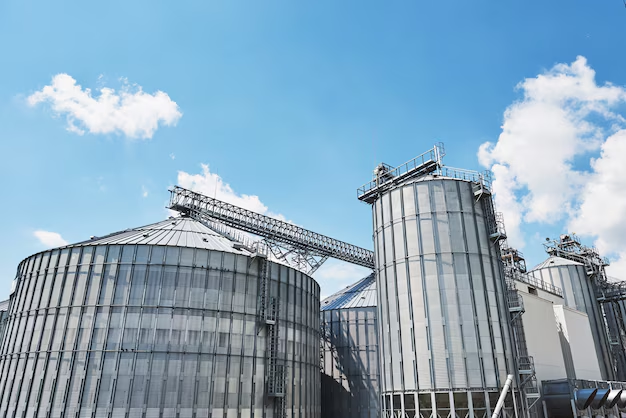
- Storage tanks
- Commercial kitchens
- Cafes, diners, school
- cafeterias, bars, and bistros
- Grease traps and vent hoods
- Trains and engines
- Railway and railroad ballast
- Gasoline service stations
- Docks, parking lots, floors, garages, sidewalks
- Machinery, sumps, rolling stock
- And much more
Safe applications are
- Pouring
- Spraying
- Flooding
- Ultrasonic cleaning
- Pressure washing
- Parts washer
- Wipe, dip, sponge, brush, or soak as your needs require
When applying to hard surfaces such as wood, aluminum, steel, and cast products use the following rates for this powerful detergent
- Dilute the product at a rate of 1:10 to 1:20 in water and apply to the distressed area for cleaning hydrocarbons.
- Let it make contact for 3- to 5-minutes. This helps to dissolve, soften, liquefy, and loosen accumulations. Keep the area moist and not let it dry out. Mist with a diluted solution or with cold water. For older grime, use a bristle brush or fiber pad. The longer the solution sits, the less work to be done.
- Rinse with water or wipe with a wet sponge or cloth.
What Heavy Detergent Cleaning Means
Standard industrial degreasers work well on light hydrocarbon films, the kind you find on shop floors or equipment exteriors. But inside tanks, vessels, and process equipment, the residue is different. You are dealing with
- Hardened crude oil depositsParaffin, asphaltene, and wax layers that have baked onto tank walls and bottoms over months or years of service
- Coke and carbon buildupCarbonized hydrocarbon deposits in coker units, heater tubes, and fractionator bottoms that resist conventional cleaning
- Heavy sludge layersMixtures of BS&W (bottom sediment and water), iron sulfide, scale, and emulsified oil that accumulate at the bottom of storage tanks
- Process foulingPolymer deposits, catalyst fines, and organic scale inside heat exchangers, reactors, and distillation equipment
These residues require a heavy-duty detergent, not a light degreaser. Hasten Cleanse is formulated with concentrated surfactants specifically selected for their ability to penetrate and break apart heavy hydrocarbon deposits that lighter products cannot touch.
Applications for Heavy Detergent Cleaning
- Semi-truck tankersTanker trucks carrying hydrocarbon derivatives require thorough interior cleaning between loads to prevent cross-contamination and eliminate explosion risk. Hasten Cleanse cleans the full interior surface and suppresses residual vapors simultaneously.
- Refinery process equipmentVacuum tower bottoms, coker fractionators, heat exchanger bundles, and process piping accumulate the heaviest hydrocarbon fouling in any industrial setting. Our chemistry dissolves these deposits without the fire risk of petroleum solvents.
- Storage tank decontaminationWhen tanks change service, crude to refined product, diesel to jet fuel, thorough decontamination prevents quality issues in the new product. Heavy detergent action ensures no residual contamination remains.
- Marine vessel cleaningCargo tanks on barges and tankers accumulate heavy residues that must be removed between cargoes. Hasten Cleanse is effective in marine environments and supports compliance with MARPOL discharge standards.
- Oilfield equipmentProduction separators, heater treaters, gun barrels, and flowlines develop heavy internal fouling that reduces efficiency. Our chemistry restores equipment performance without requiring disassembly.
Why Non-Flammable Detergent Matters
The traditional approach to heavy hydrocarbon cleaning uses petroleum-based solvents, diesel, kerosene, or proprietary solvent blends with flash points between 100°F and 140°F. These products work, but they introduce a serious fire risk into an environment that already contains flammable residues.
Every year, tank cleaning fires and explosions injure and kill workers in the petrochemical industry. The ignition source is often the cleaning chemical itself.
Hasten Cleanse eliminates this risk entirely. Our water-based formula has no flash point. It cannot ignite. We demonstrate this at every product trial by holding an open flame to a surface treated with Hasten Cleanse, no ignition, no flash, no fire.
For operations managers and safety directors, switching from flammable solvents to Hasten Cleanse removes a major hazard from your confined space and hot work procedures, simplifies your Job Safety Analysis (JSA), and reduces your liability exposure.
Schedule a Free Demo
See Hasten Cleanse perform in real-world conditions at your facility. Free on-site demonstrations available for Gulf Coast operations.
Or call 832-655-7763
Getting the Most from Heavy Detergent Cleaning
Maximizing cleaning effectiveness with Hasten Cleanse heavy detergent applications comes down to three variables, dilution, temperature, and contact time.
Dilution ratio. For heavy deposits (crude sludge, coke precursors, hardened asphaltenes), start at 1:10 to 1:15. For moderate fouling (refined product residue, light paraffin, routine maintenance), 1:20 to 1:30 is typically sufficient. Over-diluting saves product but extends cleaning time; under-diluting wastes product without proportional improvement. Our technical team recommends the optimal ratio based on your specific fouling type and severity.
Temperature. Heat is the biggest performance accelerator for heavy deposits. If you can circulate the solution through a heater or use existing heating coils, target 140-160°F. This is especially critical for paraffin and wax deposits, which soften dramatically with heat, allowing the surfactants to penetrate and lift the deposit much faster than at ambient temperature.
Contact time and agitation. The surfactants need time to penetrate heavy deposits and break the surface bond. Continuous circulation is more effective than static soaking because the fluid movement constantly refreshes the surfactant concentration at the deposit surface and carries away emulsified material. For the toughest deposits, 4-8 hours of heated circulation is typical. For moderate fouling, 1-4 hours may be sufficient.